
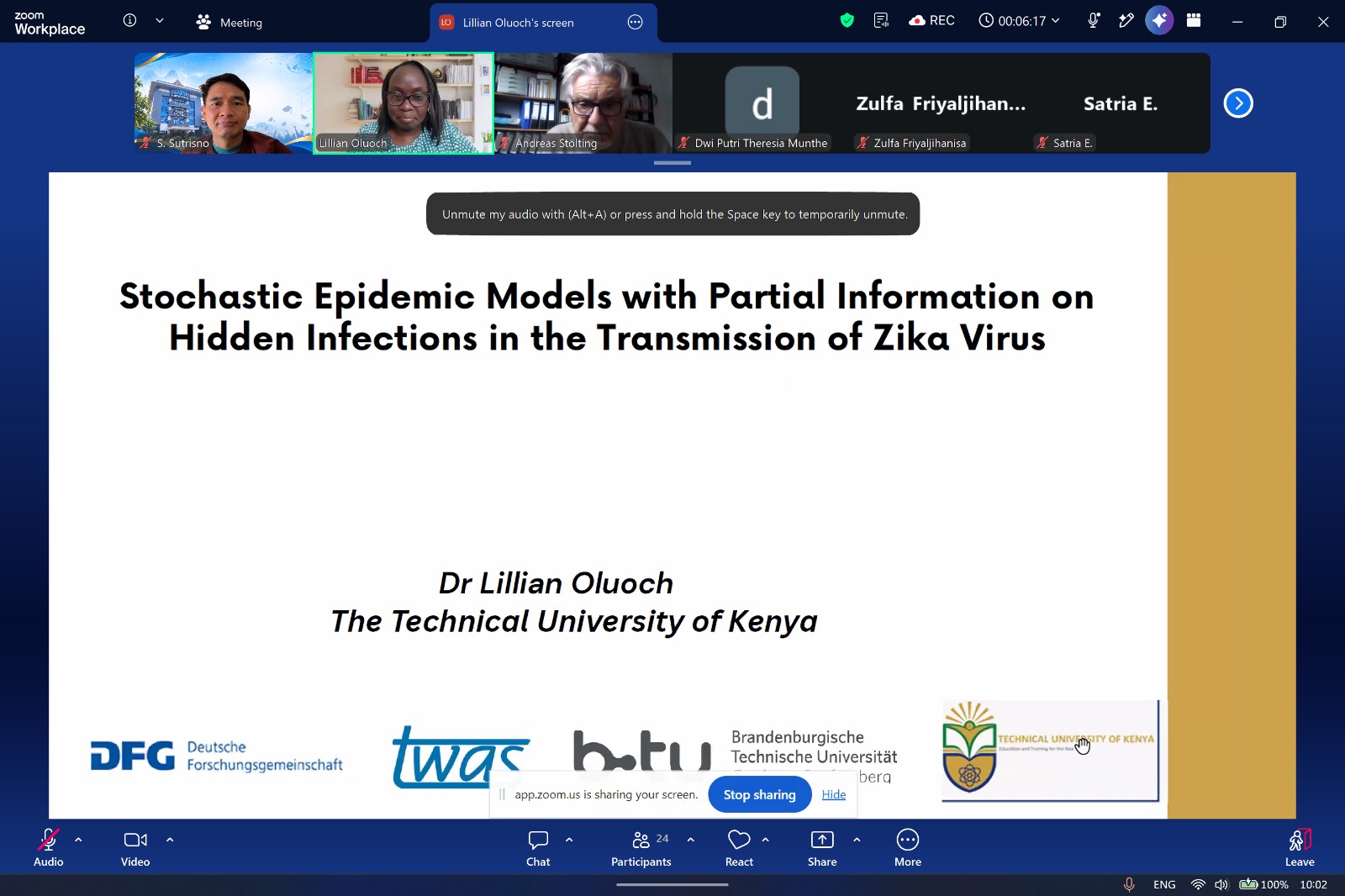
The Department of Mathematics, Faculty of Science and Mathematics, Universitas Diponegoro (UNDIP), organized an international academic session through the UNDIP Global Classroom program, featuring Dr. Lillian Uluoch from TU Kenya as the guest speaker and Dr. Sutrisno as the host. The session focused on Mathematical Modeling of Epidemics: The Case of Zika Virus Disease, highlighting the important role of mathematics in understanding and controlling infectious diseases. Two lectures were given by the speaker on Wednesdays, 21 and 28 October 2026.
The Global Classroom provided an opportunity for students and lecturers to explore how mathematical approaches can be applied to real-world public health challenges. In particular, the session introduced mathematical models describing the transmission dynamics of Zika virus, a mosquito-borne infectious disease that has attracted global attention due to its potential health consequences.
During the session, Dr. Lillian Uluoch discussed the fundamental concepts of epidemic modeling, including compartmental models, disease transmission mechanisms, and the interaction between human and mosquito populations. The discussion also highlighted how mathematical analysis can help identify factors influencing disease outbreaks, evaluate disease-free and endemic equilibria, and assess potential disease prevention and control strategies.
As the host, Dr. Sutrisno emphasized the importance of connecting mathematical theories with practical applications, particularly in epidemiology and public health. The session also encouraged students to develop their analytical thinking and recognize the relevance of mathematical modeling in addressing global challenges.
Through the UNDIP Global Classroom program, the Department of Mathematics continues to strengthen international academic engagement and provide students with broader perspectives on contemporary developments in applied mathematics.
This activity reflects UNDIP’s commitment to promoting internationalization, enriching learning experiences, and fostering global academic collaboration while demonstrating the significant contribution of mathematics to solving complex societal problems.
