
PRESS RELEASE
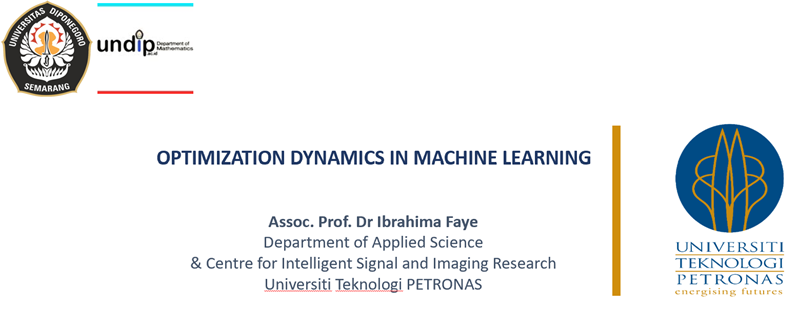
UNDIP Global Classroom Lecturer: “Optimization Dynamics in Machine Learning”
Dalam rangka memperkuat wawasan akademik dan meningkatkan pemahaman mahasiswa, khususnya mahasiswa Magister Matematika (M.Mat), terhadap perkembangan terkini di bidang matematika terapan dan machine learning, program UGC M.Mat menghadirkan kuliah bertajuk “Optimization Dynamics in Machine Learning” yang disampaikan oleh Assoc. Prof. Ibrahima Faye dari Universiti Teknologi PETRONAS, Malaysia, yang dilaksanakan dalam dua sesi yaitu pada tanggal 15 Oktober dan 22 Oktober 2026. Kegiatan ini menjadi wadah akademik untuk memperdalam pemahaman mengenai landasan matematis optimisasi serta perannya dalam pengembangan dan kinerja algoritma machine learning modern.
Kuliah ini dirancang untuk memberikan perspektif matematis yang komprehensif mengenai dinamika optimisasi, dengan memadukan fondasi teoretis yang kuat dan kerangka konseptual untuk memahami mengapa algoritma optimisasi dapat bekerja secara efektif dalam proses pembelajaran mesin. Topik ini relevan mengingat optimisasi merupakan komponen fundamental dalam pelatihan model machine learning, khususnya jaringan saraf tiruan dan deep learning.
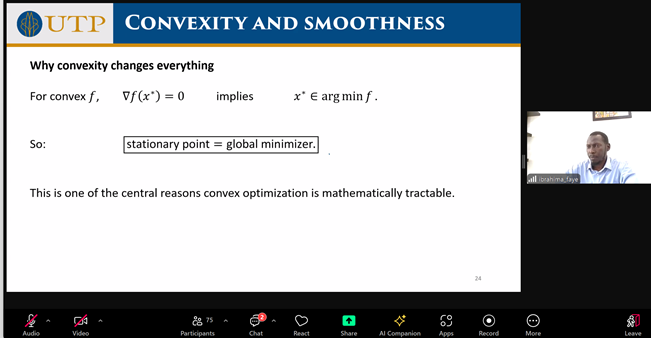
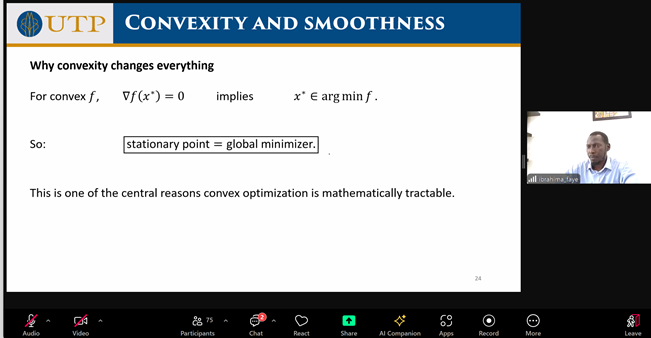
Pada sesi pertama, pembahasan difokuskan pada konvergensi metode optimisasi orde pertama (first-order methods), termasuk gradient descent dan algoritma terkait. Peserta diajak memahami dinamika optimisasi dalam waktu kontinu maupun diskret, serta bagaimana asumsi matematis seperti konveksitas, kehalusan fungsi (smoothness), dan konveksitas kuat (strong convexity) memengaruhi laju konvergensi algoritma. Selain itu, dibahas pula peran ukuran langkah (step size), fungsi Lyapunov, dan gradient flows dalam menganalisis kestabilan serta perilaku algoritma optimisasi. Selain mahasiswa Matematika S2, sejumlah mahasiswa S1 juga hadir, sehingga peserta mencapai 75 orang.
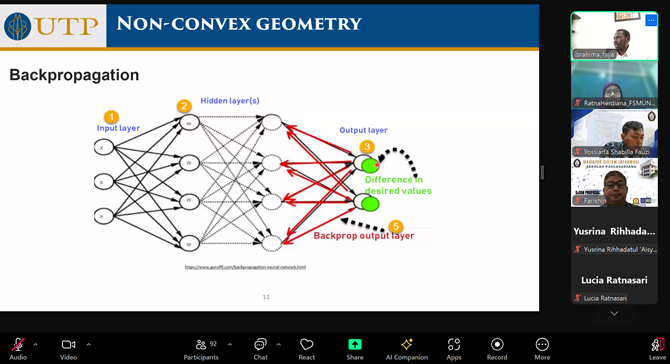
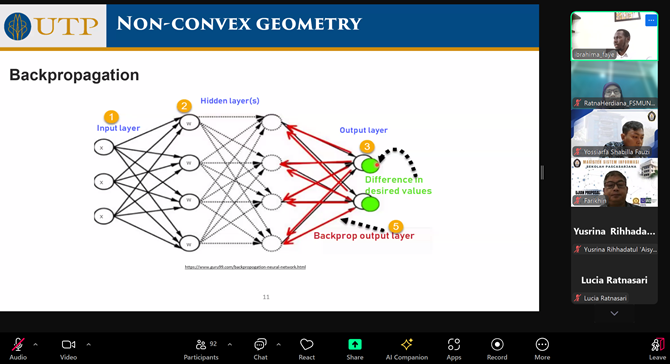
Sesi kedua mengangkat persoalan optimisasi nonkonveks dalam deep learning. Pembahasan mencakup makna konvergensi ketika sifat konveksitas tidak terpenuhi, geometri titik-titik kritis, serta alasan metode orde pertama tetap dapat menunjukkan kinerja yang baik pada permasalahan machine learning berdimensi tinggi. Perhatian khusus diberikan pada saddle points, overparameterization, dan keterkaitan antara dinamika optimisasi dengan perilaku jaringan saraf. Pada sesi kedua kuliah UGC ini, hingga 92 peserta hadir
Kegiatan UGC ini juga diharapkan memperkuat kolaborasi akademik, mendorong pertukaran pengetahuan, serta membuka peluang pengembangan penelitian interdisipliner di bidang matematika dan kecerdasan buatan.
UNDIP Global Classroom Lecturer: “Optimization Dynamics in Machine Learning”
In order to strengthen academic insight and increase students’ understanding, especially Master of Mathematics (M.Mat) students, of the latest developments in the field of applied mathematics and machine learning, the UGC M.Mat program presents an online lecture entitled “Optimization Dynamics in Machine Learning” delivered by Assoc. Prof. Ibrahima Faye from Universiti Teknologi PETRONAS, Malaysia, which was held in two sessions: October 15 and October 22, 2026. This activity is an academic forum to deepen understanding of the mathematical foundation of optimization and its role in the development and performance of modern machine learning algorithms.
This short course is designed to provide a comprehensive mathematical perspective on optimization dynamics, by combining a strong theoretical foundation and a conceptual framework to understand why optimization algorithms can work effectively in machine learning processes. This topic is relevant considering that optimization is a fundamental component in machine learning model training, particularly artificial neural networks and deep learning.
In the first session, the discussion focused on the convergence of first-order optimization methods, including gradient descent and related algorithms. Participants were invited to understand the dynamics of optimization in continuous and discrete time, as well as how mathematical assumptions such as convexity, smoothness, and strong convexity affect the convergence rate of algorithms. In addition, the role of step size, Lyapuov function, and gradient flows in analyzing the stability and behavior of optimization algorithms was also discussed. In addition to S2 Mathematics students, a number of S1 students were also present, so that the participants reached 75 people
The second session raised the issue of nonconvex optimization in deep learning. The discussion included the meaning of convergence when the properties of convection are not met, the geometry of critical points, and the reason why first-order methods can still show good performance in high-dimensional machine learning problems. Special attention was paid to saddle points, overparameterization, and the relationship between optimization dynamics and neural network behavior. In the second session of this UGC lecture, up to 92 participants attended
This UGC activity is also expected to strengthen academic collaboration, encourage knowledge exchange, and open opportunities for the development of interdisciplinary research in the field of mathematics and artificial intelligence.
