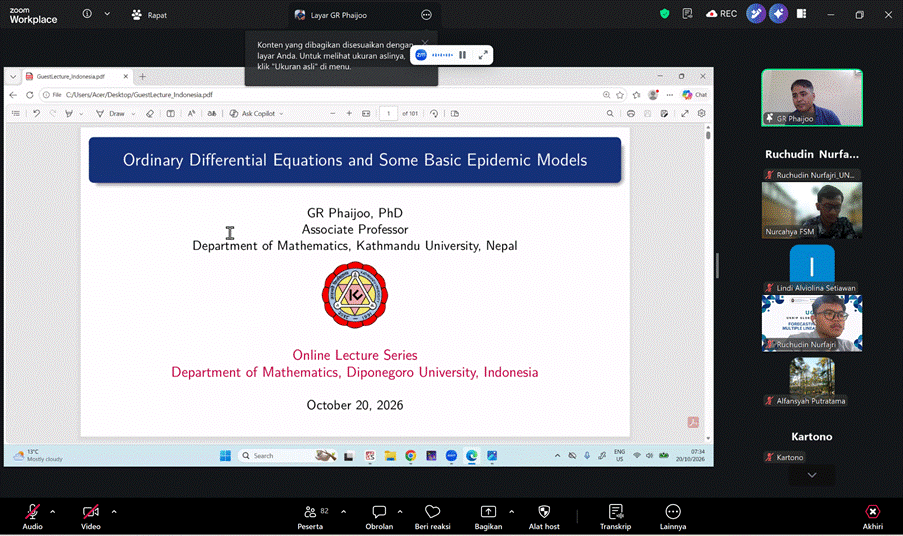
Department of Mathematics, Diponegoro University, held an online UNDIP Global Classroom (UGC) on October 20 and 27, 2026, under the theme “Differential Equations: Solution, Theory, and Applications in Epidemiology.” Featuring Ganga Ram Phaijoo, M.Phil., Ph.D., from Kathmandu University as a guest lecturer, this program discussed the application of differential equations in modeling the spread of infectious diseases.
This program was attended by second-year students of Diponegoro University who had previously acquired fundamental knowledge of differential equations. Through this program, students explored the mathematical principles underlying disease-spread models, ranging from the basic concepts of differential equations to their applications in analyzing the dynamics of infectious diseases.
The first meeting, held on October 20, 2026, revisited the fundamental concepts of differential equations used in mathematical modeling, such as equilibrium points and stability. These concepts provide an essential foundation for understanding the behavior of mathematical models and analyzing changes within a dynamic system.
Continuing the discussion, the second meeting on October 27, 2026, focused on applying differential equations to model the spread of infectious diseases. One of the key topics introduced was the basic reproduction number, an important epidemiological parameter used to assess the potential transmission of an infectious disease and understand its spread within a population.
Through UNDIP Global Classroom, Department of Mathematics, Diponegoro University, provides students with opportunities to engage directly with international academics and gain broader academic perspectives. This initiative also enriches students’ learning experiences by fostering interaction within an international academic environment.
Furthermore, this event serves as a platform to introduce students to mathematical modeling approaches in epidemiology. By connecting theoretical concepts learned in the classroom with real-world applications, students are expected to gain a deeper understanding of how mathematics can be applied to investigate and analyze epidemiological phenomena.